ECHO.
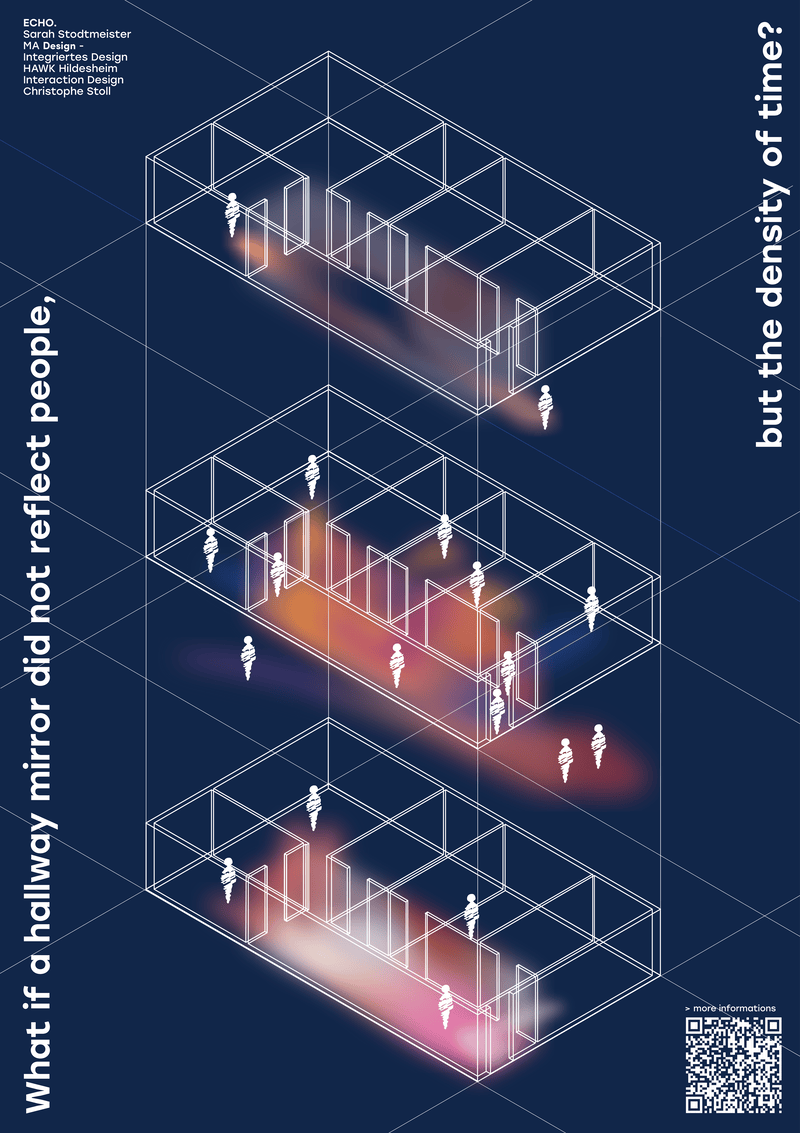
What if a hallway mirror did not reflect people, but the density of time?
A research exploration into the material qualities of shared space. ECHO. investigates how presence accumulates in time, transforming a hallway mirror into a visualization of social density and collective traces.
Rather than showing immediate reflections, ECHO. visualizes the accumulation of presence. Each person passing through the space leaves a trace, building up layers of temporal density that transform the perception of the corridor itself. The mirror becomes a record of shared experience.
Design not as solution, but as investigation. ECHO. does not optimize, instruct, or demand interaction. It exists as a perceptual field. There are no buttons, no interfaces, no explicit instructions. The interaction emerges through presence itself, through the simple act of being there.
ECHO operates in a space of ambiguity. It invites a different mode of attention: one based on perception rather than interaction, on witnessing rather than using. The work explores implicit interaction: engagement that happens without conscious effort, simply through presence, touching on questions of multimodal perception and how we sense and understand space through overlapping channels of light, movement, and time.
Ultimately, ECHO asks us to reconsider our relationship with everyday spaces. What if transitional corridors were not just empty passages, but sites of accumulated meaning? What if we could see the density of shared life, made visible through time?