Habitat
What if each room helped you stay with what you came there to do?
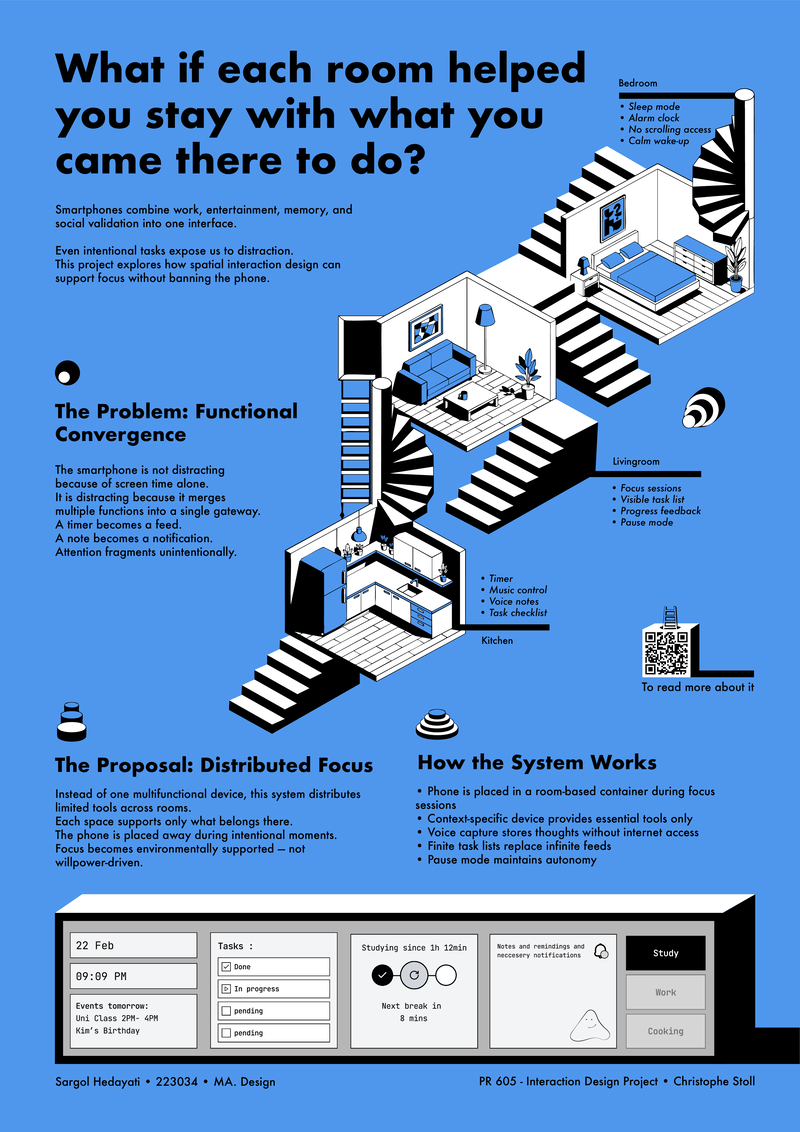
The smartphone is not distracting because of screen time alone. The deeper problem is function convergence: one object is simultaneously a tool, a communication device, a memory archive, a source of entertainment, and a validation machine. You unlock your phone to set a timer and see a message. You check a recipe and a notification appears. Distraction is almost unavoidable, not because of weak willpower, but because of how the device is designed.
This project proposes a distributed, room-based alternative. Instead of one multifunctional device, the system spreads limited tools across the home. Each space supports only what belongs there. During a focus session, the phone is placed inside a physical container in the room: a deliberate, tactile commitment. The act of placing it away becomes a ritual. A clear beginning.
Each room gets a dedicated companion device with context-specific tools only. The kitchen: timer, music control, voice notes, task checklist. The study: focus timer, task list, progress tracking. The bedroom: alarm clock, sleep mode, minimal clock display. Smartphones ignore situational context. This system restores it.
Voice capture lets users record thoughts without going online, like carrying a notebook rather than opening a browser. Finite task lists replace infinite feeds. Focus sessions have a clear start, duration, and end. Pause mode preserves autonomy: the phone can be retrieved. The system is not a restriction tool. It is a redesign of the environment around intentional use.
Distraction is architectural, not just behavioral. Focus can be designed environmentally. The result is not less technology: calmer, clearer, more intentional interaction.