Meo
What if taking care of a Tamagotchi could help you take care of yourself?
Tamagotchi have been fading since the early 2000s. Their DNA lives on in Siri, health trackers, and gamified apps, but the original has largely been abandoned. Meo asks what happens when that format is reactivated, not as nostalgia, but as necessity.
The premise is disarmingly simple: many of us spend our days glued to screens (for work, for entertainment, for doomscrolling) and our own basic needs quietly take a backseat. Meo turns this dynamic around by making the virtual pet a mirror. Instead of its needs being separate from yours, they are yours.
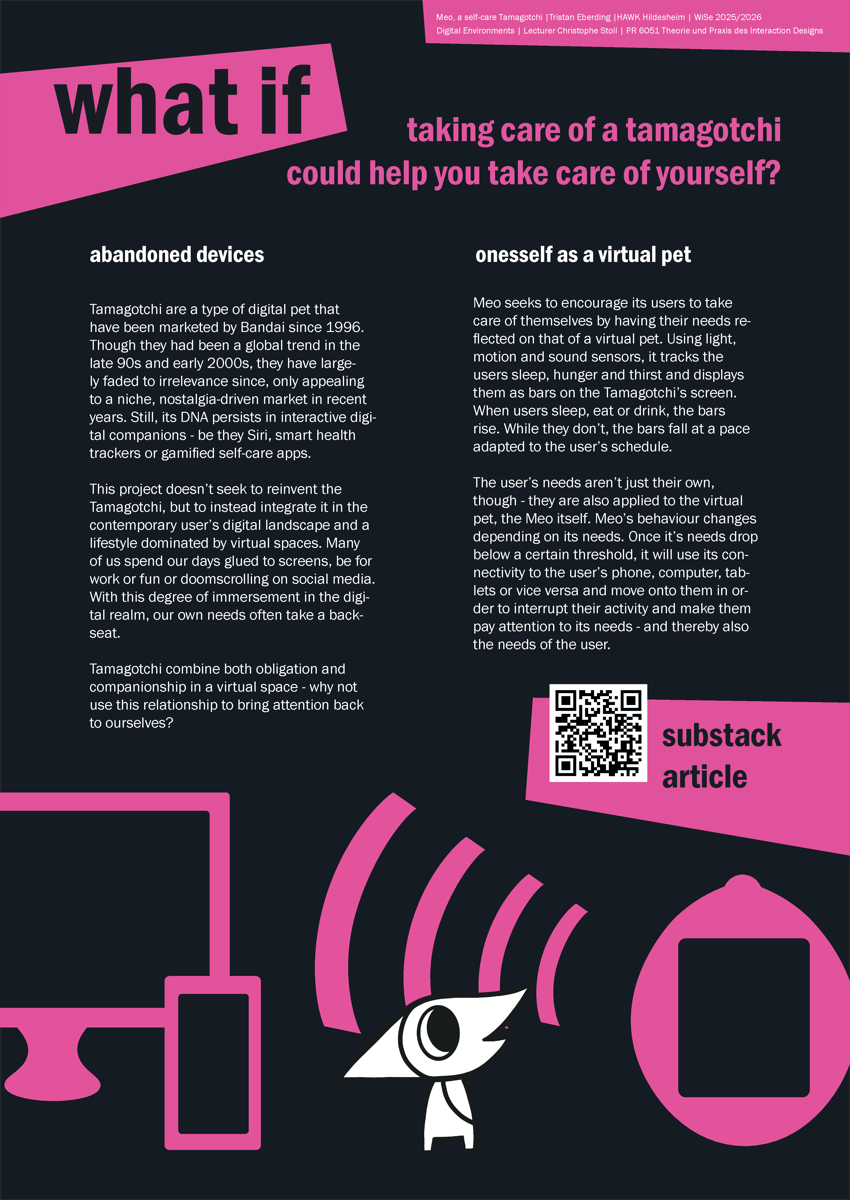
Using light, motion, and sound sensors, Meo tracks when you sleep, eat, and drink, and reflects those states as bars on its screen. When you take care of yourself, the bars rise. When you don’t, they fall at a pace calibrated to your schedule. But Meo doesn’t just wait passively. Once its needs drop below a threshold, it uses its connectivity to interrupt whatever you’re doing on your phone, computer, or tablet, pulling your attention back to the basics.
The character is an anthropomorphic bird with large, childlike eyes and a gender-neutral design rendered in pixel-style graphics. The interface is deliberately minimal: only three needs (sleep, hunger, thirst), no clock, nothing redundant. Tamagotchi combine obligation and companionship in a virtual space. Meo uses that relationship to bring attention back to the person holding it.