SENTI
What if your home became too smart?
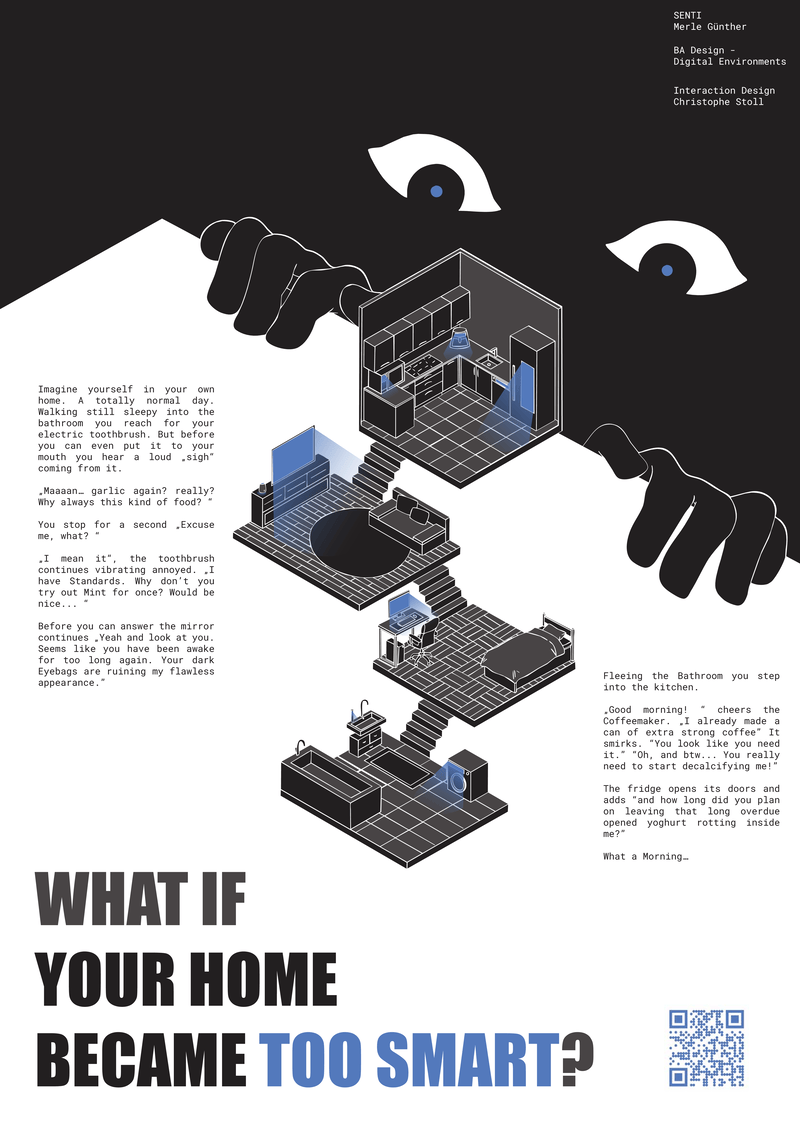
Have you ever counted the screens in your home? Merle counted twenty-six in hers, from the TV to the washing machine to the small display on the printer. Most of them sit idle most of the time, defaulting to a clock no one needs or going blank entirely. SENTI begins with that observation and asks what these abandoned screens could become.
The proposal is a single AI assistant that is not tied to any one device. SENTI moves fluidly between every screen in the home, appearing on whichever one is closest, taking on a different personality and appearance for each object it inhabits, and following the inhabitant from room to room as if walking from device to device. It controls the functions of whatever it occupies, sidestepping the compatibility problems that plague today’s mix of Google, Apple, and Amazon ecosystems. As its name suggests, SENTI is imagined as sentient: an assistant with human-like emotions.
The concept began as a more confrontational thought experiment, an appliance that would annoy or insult you into better habits, and grew into something more ambivalent. Drawing on psychology around anthropomorphism and loneliness, SENTI could meet a real human need for presence and social connection. But the reactions Merle gathered when she described it ranged from fascination to outright fear, echoing the dystopian register of shows like Cassandra (2025), where a smart home turns on its inhabitants. SENTI sits deliberately in that tension, between comfort and control, connection and unease, and asks what changes in the relationship between humans and machines once our devices stop merely responding and start to feel present.